



令和8年度 東京大学秋季学位記授与式・卒業式 総長告辞
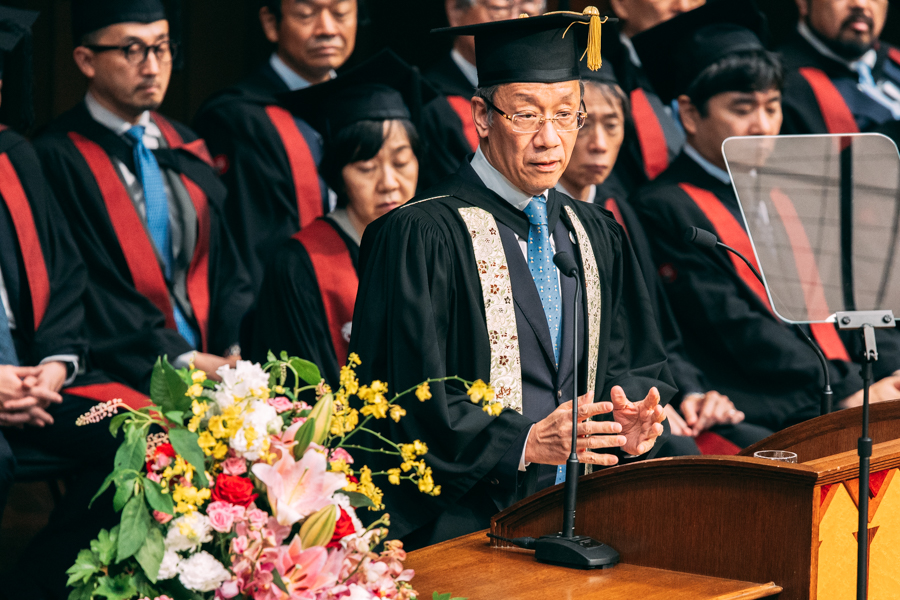
Address by the President of the University of Tokyo at the AY 2026 Autumn Commencement Ceremony
To all of you receiving your bachelor’s, master’s, doctoral, and professional degrees today, I offer my heartfelt congratulations. I have the deepest respect for the efforts that have brought you here. On behalf of the faculty and staff of the University of Tokyo, I extend my warmest wishes. I also want to convey both my congratulations and my gratitude to your families, who have encouraged and supported you along the way.
This past July, only ten years after the Kumamoto earthquake of April 2016, another major earthquake struck the Kumamoto area. As I am sure you all remember, the impact was widespread, and many homes were damaged or destroyed. With power and water cut off and the movement of goods disrupted, large numbers of people were forced to leave their homes and live as evacuees. The Japanese archipelago is one of the most seismically active places in the world, and the tragedy of earthquakes and the hard work of recovery have been repeated here time and again.
Earthquakes are caused by the sudden slipping of faults—fractures in the rock beneath the ground. But much about earthquakes remains unknown. In particular, we cannot say in advance exactly when, where, or on what scale such fault movements will occur.
Seismographs, the instruments we use to continuously record the shaking of the ground, were first developed about a hundred and fifty years ago. During the Great Kantō Earthquake of 1923, the tremors that devastated Tokyo and Yokohama were so violent that the needles of the seismographs swung right off the scale. The ground motion could not be recorded accurately. By the early years of the twenty-first century, however, new high-performance seismographs had been installed throughout Japan. These instruments can measure even powerful shaking with precision, and together they form an observation network covering the entire archipelago. Around the same time, satellite observations also came to be used to map changes in the Earth’s surface. Because satellites capture change across entire areas rather than at isolated points, we have become able to grasp in detail what actually happens when a fault moves.
Even so, for all the wide variety of observational data and information we can now draw on, we still cannot directly see the actual seismic phenomena as they unfold underground. All we can do is watch the movements of those faults as if through a clouded lens.
Here lies a question that goes to the very heart of scholarly inquiry: how do we grasp what we cannot see?
Now, what does it actually mean for us to “see”? Today I would like to reflect on both the possibilities and the risks of seeing.
In physiological terms, seeing begins with light entering the eye. The retina converts the information carried by the light into electrical signals that are sent to the brain. The brain then reconstructs those signals into a meaningful image. Our vision is thus more than just our eyes capturing the information carried by light. It is also our brains interpreting that information.
In the history of life, the evolution of the eye marked a great turning point. Trilobites, the ancient sea creatures that emerged in the Cambrian period, are thought to be among the first animals to possess sight. First to appear were simple organs that could sense only the presence of light. Over time, they developed into organs that could discern shape, detect movement, and judge distance.
What is known as the Cambrian explosion, some 500 million years ago, is now said to have been not so much a sudden diversification of life forms as an explosive increase in the number of organisms preserved as fossils. It is a record of what happened once many creatures had acquired hard shells, exoskeletons, and similar structures—the parts of a body that remain as fossils. Behind this, scientists point to an intensifying struggle for survival—a struggle that the development of the eye had set in motion. Gaining the power of sight vastly expanded the amount of information that creatures could process. They could now find and pursue prey more efficiently. They could find out targets and strike. And at the same time, they acquired the ability to detect enemies quickly, to escape, and to hide.
Human beings have greatly extended our power to know by inventing a variety of tools for seeing. The microscope opened the door to the world of microorganisms and cells; the telescope turned distant stars into objects that could be observed; and X-rays made it possible to see inside solid objects and the human body—interiors hidden from the outside. The history of science is also the history of overcoming the physiological limits of the human eye. There is an old saying, familiar throughout East Asia: “Hearing something a hundred times is not as good as seeing it once.” One direct look, in other words, is worth more than any amount of hearsay. There is great power in seeing for ourselves.
A striking example is the work of Professor Hiroyuki Noji, now of our Graduate School of Engineering. In 1997, using a technique for visualizing single molecules, he directly observed the rotation of ATP synthase, the enzyme that sustains the activities of life. Until then, the idea that this enzyme rotates had been only a hypothesis, inferred from indirect evidence. Now it appeared, quite literally, right before our eyes. That same year, a share of the Nobel Prize in Chemistry was awarded to Paul Boyer, who had proposed the rotational model of ATP synthase, and to John Walker, whose structural analysis of the enzyme had supported it.
The power of the human eye has been further freed from the constraints of our bodies by cameras and sensors aboard satellites and by probes sent to distant planets, allowing us to look at the world and the universe afresh from entirely new vantage points. I myself have sent underwater robots equipped with microfluidic devices—tiny laboratories on a chip—into the deep sea, far beyond sunlight and the reach of our unaided senses. Through them I have sought to capture, from the seawater itself, the genetic information of microorganisms and the traces of biological activity. It was an attempt to extend the human gaze into the deep ocean and to put questions to the sea itself.
The advance of artificial intelligence in our own day can likewise be regarded as the evolution of a new kind of eye. Machines have begun to acquire useful eyes of their own—in self-driving cars, in industrial robots, in facial recognition, in medical imaging. These eyes do not merely mirror the world by recording images and data; they recognize what is there. As in the Cambrian period long ago, the development of these new eyes is beginning to change our world.
And yet, however much our power to see may increase, seeing alone does not mean that the world is understood. Understanding requires us to do what the brain does: to relate one piece of data to another, to search out meaning in different pieces of information, and to build up a framework for interpreting them.
Understanding can take a long time. About 800 years ago, the celebrated poet Fujiwara no Teika kept a diary known as the Meigetsuki. In it he recorded “guest stars”—stars that had suddenly appeared in the night sky and, in time, vanished. He drew his accounts from older records kept by the astronomers of the Imperial court. He noted those events, presumably, because in his day an anomaly in the night sky was regarded as a momentous message from Heaven. Seven centuries later, in 1934, a Japanese amateur astronomer named Yasuaki Iba reported the diary’s records of guest stars in the American magazine Popular Astronomy. His article caught the attention of astronomers around the world who were then studying supernova explosions. A few years later, researchers in Europe and the United States published papers linking the Crab Nebula to a supernova explosion that had been observed in China and Japan in the year 1054. That supernova was one of the very guest stars recorded in Teika’s diary.
Even as methods of observation and analysis advance, and even when records are shared across the centuries, there remain things we cannot see and phenomena we cannot yet fully understand. That is why we imagine the existence of the unseen, frame questions about it, and keep searching for new ways to approach it. In 1987, the University of Tokyo’s neutrino observatory Kamiokande succeeded in detecting neutrinos—elementary particles that no eye can see—from supernova explosions. This facility did much to open the path to understanding the mysteries of the Universe through the observation of neutrinos. And research on neutrinos led to two Nobel Prizes in Physics: to Special University Professor Emeritus Masatoshi Koshiba in 2002, and to Distinguished University Professor Takaaki Kajita in 2015.
Trying to see the invisible; probing for things whose existence is only hinted at; inferring movement and structure from the traces we perceive—challenges like these are what drive scholarship forward. “Dark matter” is the name given to whatever lies behind the way galaxies move and light bends—behavior that cannot be explained based only on the stars and gas that we can see. In the life sciences, “dark proteins” are proteins whose structures and functions are not yet fully understood. They hold the potential to reveal hidden mechanisms of life and to lead to new drugs.
That we have not yet seen something does not mean that nothing is there. On the contrary, it is precisely in such unknown places where we might find the hidden keys that will rewrite our present understanding and open up a new future.
There is another reason why seeing alone is not enough to understand the world. Even when we are all looking at the same thing, the world each of us sees is not necessarily the same. For that reason, too, simply believing whatever we ourselves have seen can be risky. Precisely because we live in an age in which anyone can easily create fake images with AI, we must never jump straight from seeing to believing.
Some time ago, I had a conversation with the artist Katsuhiko Hibino, who is President of the Tokyo University of the Arts. He said that if a hundred people were each to draw an apple, no two of those apples would be the same. Even when people are imagining the same fruit, they perceive its shape, color, and texture in many different ways. Behind those differences must lie differences in how our brains and nervous systems work, and in what each of us has felt when touching or tasting apples. Each person’s manner of expression will differ as well. The act of drawing thus reveals the differences among us, and it lets us recognize and respect those differences in one another.
There is much value in encountering ways of seeing that differ from our own. How does the thing before us appear to other people, and what do they sense from it? We take in those differences and acknowledge that there are worlds we ourselves cannot see. Then we talk to each other, and in light of what the others say, we re-examine our own thinking in turn. In that back-and-forth, we come to recognize preconceptions and limits in our ways of seeing that we could not have noticed on our own. Little by little, we widen our field of vision.
Here lies the meaning of dialogue.
In the Analects, the collection of the teachings of Confucius, there is a saying: “The noble-minded seek harmony, not sameness; the small-minded seek sameness, not harmony.” It teaches us to cooperate harmoniously with those around us, but not merely to fall in line with them. We should think and decide for ourselves. What matters in dialogue is neither forcing ideas into one mold nor simply agreeing with others for no reason, but deepening our understanding while acknowledging our differences. Only in that spirit of tolerance can we search together for answers that are not yet visible to anyone. A question asked in order to understand another person is not the same as a question asked in order to defeat them. Both seeing and questioning require humility and imagination.
At the University of Tokyo, you have acquired knowledge and methods for approaching what we cannot see. You have also developed the disposition to listen to those who see things differently from you. Both, I believe, will be valuable assets that you have gained at this university.
Professor Shōzō Fujita of Hosei University was a historian of political thought who had studied in our Faculty of Law. He is said to have often put two questions to researchers: How many times have you reread that book? And how many times have you rewritten that manuscript?
Reading the same book over and over may seem wasteful and eccentric in our present age, when so many people rush to pursue new information and rely on AI-generated summaries to try to understand things. But observation means looking carefully at what a thing really is; it is the foundation of analysis and of understanding. Thus observation does not end with a single glance. Similarly, interpreting data accurately and understanding a book deeply require us to return to them again and again, even when understanding does not come easily. The same is true of dialogue.
At the University of Tokyo, each of you has developed the strength to keep facing challenges with tenacity. I am confident that this strength will enrich the life that lies ahead of you. I hope that, with each step you take, you will bring new light to scholarship, to society, and to the future.
Once again, my heartfelt congratulations to every one of you.
FUJII Teruo
President
The University of Tokyo
September 18, 2026
(和文)令和8年度 東京大学秋季学位記授与式・卒業式 総長告辞
本日ここに、学士、修士、博士、また専門職の学位記を受け取られるみなさん、おめでとうございます。これまでのみなさんの努力に深い敬意を表し、東京大学教職員を代表して、心からお祝いを申し上げます。みなさんをこれまで励まし支えてくださったご家族の方々にも、お祝いと、そして感謝の気持ちをお伝えしたいと思います。
さて、2016年4月の熊本地震から10年しか経っていない今年7月、熊本地方で再び大きな地震が発生しました。被害は広範囲に及び、多数の家屋が損壊したほか、停電や断水、物流の停滞などで多くの方々が避難生活を余儀なくされたこと、みなさんの記憶にも新しいかと思います。日本列島は世界でも特に地震活動が活発な場所のひとつであり、震災の悲劇と復興の努力が何度となくくりかえされています。
地震の原因は、地下の断層が急激にズレ動くことですが、多くのことがまだわかっていません。とりわけ、いつ、どこで、どれほどの規模の断層運動が起こるのかを、事前に正確に予測することはできません。
ふりかえってみると、地面の揺れを連続的に記録する地震計が登場したのは、およそ150年前でした。1923年の大正関東地震の際には、揺れが大きく、多くの地点で地震計の針が振り切れ、地面の動きを正確には捉えられませんでした。しかし、21世紀初頭には、大きな揺れも精確に測定できる高性能の地震計が各地に設置され、日本列島を覆う観測ネットワークが整備されました。同じ時期に、人工衛星を利用した地表観測も導入され、変化を面的に捉えることにより、断層運動の実態をくわしく把握できるようになりました。
さまざまな観測データや情報を活用できるようになりましたが、私たちは地下で進行する地震現象そのものを直接見ることはできません。いわば曇ったレンズを通して、地下の断層の動きを見ているにすぎないのです。
そこには、「見えないものをどう捉えるのか」という、学問的探究の根本に関わる問いがあります。
そもそも私たちにとって「見る」とは、どういうことなのか。その可能性と危険性を考えてみたいと思います。
生理学的に言えば、「見る」とは、目に入った光の情報を網膜で電気信号に変えて脳へ送り、脳がそれを意味のある像として再構成する働きです。つまり私たちの視覚は、目で光の情報を捉えるだけではなく、脳による解釈をともなって成りたっています。
生命の歴史において、目の進化は大きな転換点となりました。カンブリア紀にあらわれる三葉虫は、最初に視力をもった生物の一つだとされています。光を感じるだけの単純な器官は、やがて形を捉え、動きを察知し、距離を測る器官へと発達しました。
約5億年前の、いわゆる「カンブリア爆発」は、現在では生物進化の急激な多様化ではなく、化石として残る生物が爆発的に増えたことだとされています。それは、多くの生物が硬い殻や外骨格などの組織をもつようになった結果でもありました。その背後には、目の発達がスイッチを入れた生存競争の激化が指摘されています。見る力を得たことで情報処理量が飛躍的に拡大し、生物は獲物を効率的に見つけて追いかけたり、狙いを定めて襲ったりすることが可能になるとともに、敵をすばやく察知して逃れ、身を隠す能力も身につけたことがわかります。
さらに人類は見るためのさまざまな道具を発明することによって、知る力を大きく拡張してきました。顕微鏡は、微生物や細胞の世界の扉を開き、望遠鏡は遠い星々を観測の対象へと変え、X線技術は外側からは見えない身体や物体の内部を透視する道を開きました。科学の歴史とは、人間の眼の生理的な限界を乗りこえてきた歴史でもあります。「百聞は一見にしかず(多くの伝聞よりも一度の実見のほうが確かである)」と言われるように、直接見ることには大きな力があります。
本学の野地博行教授が、1997年に一分子可視化技術を用いて、生命活動を支えるATP合成酵素の回転運動を直接観察した研究は、その象徴的な例です。それまで間接的な証拠から仮定されていた回転説が、文字どおり目に見える形で示されたのです。そして同年のノーベル化学賞がATP合成酵素の回転モデルを提唱していたPaul Boyerと構造解析による裏付けを与えていたJohn Walkerに授与されました。
一方で、人工衛星に積まれたカメラやセンサー、遠い惑星へ送られた探査機は、人間の眼の力を身体の制約から解き放ち、新たな位置から世界を見つめなおすことを可能にしました。私自身も、太陽の光が届かず、人が近づけない深海に、マイクロ流体デバイスを搭載した海中ロボットを送り、海水の成分から微生物の遺伝情報や生命活動の痕跡を捉えようとしてきました。それは、人間のまなざしを深海へと広げ、海そのものに問いかける試みでした。
今日におけるAIの進歩も、新たな目の進化と考えることができます。自動運転、産業用ロボット、顔認証、医療画像診断などの機械は、画像やデータを記録し世界を映すだけでなく、そこに何があるのかを読み取る、実用的な「眼」を持ちはじめたからです。かつてのカンブリア紀と同じように、この新たな眼の発達は、私たちの社会を変えはじめています。
しかし、見る力がどれほど高まっても、それだけで世界が分かるわけではありません。第一に「見る」ことは、そのまま「わかる」ことではないからです。理解するためには、脳がそうしているように、データを関連づけ、さまざまな情報の意味を探り、解釈する枠組みを組み上げていくことが必要です。
理解するために、長い時間がかかることもあるでしょう。今から約800年前、歌人の藤原定家(ふじわらのていか)は、夜空に突然現れ、やがて見えなくなった「客星(かくせい)」のことを過去の陰陽寮の記録から引用し、日記『明月記』に書き残しました。当時、夜空の異変が「天」からの重大なメッセージと考えられていたからでしょう。それから約700年後の1934年、日本のアマチュア天文家、射場保昭(いば やすあき)氏が、『明月記』の客星の記録をアメリカの天文雑誌に紹介しました。この情報は当時、超新星爆発のことを研究していた世界の天文学者たちに注目されました。そして1942年には、欧米の研究者たちによって、「かに星雲」を1054年に中国や日本で観測された超新星爆発と関連づける研究が発表されることとなります。
観測や分析の方法が進歩し、記録が時代をこえて共有されても、なお見えないもの、まだ十分には理解できないものが残ります。だから私たちは、見えないものの存在を想像し、問いを立て、それに迫る新たな方法を探し続けます。東京大学の「カミオカンデ」は、超新星爆発によって地球に降り注いだ目に見えない素粒子ニュートリノを、1987年に捉えることに成功しました。こうした挑戦を通じて、ニュートリノの観測から宇宙の謎を解き明かす研究の道が大きく切り拓かれ、小柴昌俊特別栄誉教授の2002年のノーベル物理学賞や、梶田隆章卓越教授の2015年のノーベル物理学賞へと結びつきました。
「見えないものを見る」「存在が示唆されているものを探る」「見えた痕跡からその動きや構造を推理する」などの挑戦は、学問を前に進める力でもあります。いわゆる暗黒物質は、宇宙に見えている星やガスだけでは説明できない銀河の運動や、光の曲がり方の背後に存在する何かを指し、生命科学のダークプロテインは、構造や機能がまだ十分には解明されていないタンパク質で、生命現象の隠れたメカニズムの解明や創薬につながる可能性を秘めています。
まだ見えていないことと、そこに何も存在しないことは、同じではありません。むしろ、そうした未知の領域にこそ、これまでの理解を塗り替え、未来を開く鍵が隠されているのです。
見る力が高まっても世界が分かるわけではありません。同じものを見ていても、そこに見えている世界が、一人ひとり同じとは限らないからです。それゆえに、自分が見たことをそのまま信じてしまうのは、危ういことだとも言えます。AIで簡単にフェイク画像をつくれてしまう時代だからこそ、見ることと信じることを短絡させてはなりません。
以前、東京藝術大学の日比野克彦学長との対談で、100人の人がリンゴの絵を描けば、そこで描かれるリンゴは一つとして同じものにはならない、という話を伺いました。同じリンゴを思い浮かべても、その形や色、質感の捉え方などは多様で、その背景には、脳や神経の働き方や、リンゴに触れたり味わったりした際の感じ方の違いがあるはずです。さらに、ひとそれぞれの表現の仕方も異なるでしょう。絵に描く表現それ自体が一人ひとりの違いを示すとともに、その違いを互いに認め尊重するきっかけにもなるわけです。
自分とは異なる見方に触れることには、大きな意味があります。目の前にあるものが、他者にはどのように映り、そこから何が感じ取られているのか。その違いを受け止め、自分には見えていない世界の存在を認める。そのうえで言葉を交わし、相手の言葉を受けて、自分の考えも見直していく。そうした往復のなかで、私たちは、自分だけでは気づけなかった思い込みや見方の限界を知り、視野を少しずつ広げていきます。
ここに、対話の意味があります。
孔子の教えを集めた『論語』に、「君子(くんし)は和(わ)して同(どう)ぜず、小人(しょうじん)は同じて和せず」という成句があります。これは、周囲と和やかに協調しながらも見識抜きに迎合することなく、自ら考え、判断する姿勢の大切さを説いています。対話において大切なのは、考えを無理やり一つにまとめることでも、わけもなくただ他人に賛同することでもなく、お互いの違いを認めながら理解を深めていくことです。そうした寛容においてはじめて、まだ誰にも見えていない答えを、ともに探していくことができるのです。相手を理解しようとする問いと、相手を打ち負かそうとする問いは、同じではありません。見ることにも、問うことにも、謙虚さと想像力が求められます。
みなさんは東京大学で、見えないものに迫るための知識や方法とともに、自分とは異なるまなざしに耳を傾ける姿勢を育んできました。それらはいずれも、みなさんが大学で培った大切な財産ではないでしょうか。
本学の法学部で思想史を学んだ法政大学の藤田省三教授は、本を何度読みかえしたか、原稿を何度書きなおしたかを、よく研究者たちに訊ねていたといいます。
同じ本を何度も読みなおすなどということは、新しい情報を追いかけるのに忙しく、AIによる要約にたよって事柄を理解しようとする人々が多くなったいまの時代からすれば、無駄で奇妙なふるまいのように思われるかもしれません。しかしながら、観察は対象の実態を注意深く見つめ、分析や理解の基礎となる行為ですから、一度見ればそれで終わりではありません。同じように、データを精確に解読することや、書物を深く理解することは、じつはめげずに読みなおし、懲りずに読みかえす行為を幾重にも含みこんで成立しているのです。
対話もまた、同じではないでしょうか。
みなさんが大学で身につけた、課題と粘り強く向かいあう力が、これからの人生をより豊かなものにしていくことを信じています。その一歩一歩が、学問に、社会に、そして未来に、新しい光をもたらすことを期待しています。
本日は、まことにおめでとうございました。
令和8(2026)年9月18日
東京大学総長
藤井 輝夫
関連リンク
- カテゴリナビ


